In una delle sale del piano nobile, la cui deliziosa decorazione del soffitto rimanda al periodo ottocentesco del Palazzo, è ospitato il Portale del Biduino, copia esatta dell’originale in marmo, oggi conservato presso The Met Cloister a New York.
Dedicato a San Leonardo, il portale fu scolpito nell’ultimo quarto del XII secolo dal Biduino, scultore e architetto attivo a Lucca e Pisa, autore di numerose opere firmate o a lui attribuiti stilisticamente.
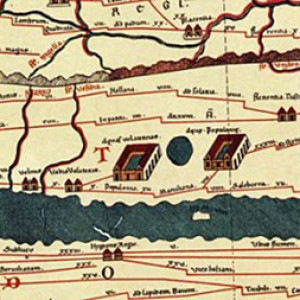
Il portale era posizionato all’ingresso della Chiesa di San Leonardo al Frigido, sulle rive del fiume Frigido di Massa, già mansio romana della Via Aemilia Scauri, strada romana costruita nel II secolo a.c. Questa stazione di cambio d’epoca imperiale era nota come Ad Tabernas Frigidas ed è raffigurata nella celebre Tavola Peuntigeriana (dettaglio nell’immagine in basso), carta medioevale, copia di una carta antica raffigurante l’incredibile reticolo dell’impero romano.
A seguito di abbandono del sito in epoca tardo medievale, il portale venne venduto dai proprietari dell’edificio, ormai divenuto privato, alla fine del XIX secolo e trasferito in Francia. Successivamente venne trasferito al Metropolitan Musem of Art di New York, nella sezione The Cloisters. È lì che, verso la fine degli anni ‘80 del ‘900, fu realizzato il calco, qui esposto, ad opera dell’architetto Pier Luigi Zonder Mosti.
Il rilievo, ricco di simbologie e significati per l’uomo del Medioevo, descrive sul lato sinistro l’Annunciazione e la Visitazione, sul lato
destro San Leonardo, protettore dei prigionieri (il Santo sostiene tra le braccia un uomo in catene) e delle donne
gravide (Maria ed Elisabetta, visibilmente incinte). L’architrave mostra l’immagine dell’ingresso di Cristo in Gerusalemme.
Oggi la Chiesa di San Leonardo è un santuario laico, testimone del terribile eccidio nazifascista del 16 settembre 1944, che vide fucilati, sull’argine del fiume, 159 prigionieri politici e detenuti comuni, nota come Strage delle Fosse del Frigido. Le salme furono scoperte e riesumate solo tre anni dopo, nel 1947, e l’Amministrazione Provinciale volle, negli anni a seguire, acquistare e ristrutturare l’antico edificio ormai abbandonato perché ne fosse imperituro testimone.
The Biduino’s portal
In one of the rooms on the noble floor, whose elegant ceiling decoration reflects the 19th-century phase of the palace, there is the Portal of Biduino, an exact copy of the original marble work now preserved at The Met Cloisters in New York.
Dedicated to Saint Leonard, the portal was carved in the last quarter of the 12th century by Biduino, an artist active in Lucca and Pisa.
The portal originally stood at the entrance of the Church of San Leonardo al Frigido, on the banks of the Frigido River in Massa, an area that in Roman times was a mansio along the Via Aemilia Scauri, a Roman road built in the II century B.C. This imperial era stopping point was known as Ad Tabernas Frigidas and is shown in the famous Tabula Peutingeriana, a medieval copy of an ancient map depicting the vast network of the Roman Empire.
After the site was abandoned in the late Middle Ages, the portal was sold by the owners of the building at the end of the 19th century and moved to France. It was later transferred to the Metropolitan Museum of Art in New York, in the section of The Cloisters. There, in the late 1980s, a cast was made by architect Pier Luigi Zonder Mosti, which is the copy displayed here.
Rich in symbolism, the relief shows the Annunciation and the Visitation on the left side, while on the right it depicts Saint Leonard, protector of prisoners (shown freeing a chained man) and of pregnant women (represented by Mary and Elizabeth). The lintel shows Christ’s entry into Jerusalem.
Today, the Church of San Leonardo is a secular memorial site, witnessing the Nazi-Fascist massacre of 16 September 1944, when 159 political prisoners and common prisoners were executed on the riverbank in what is known as the Frigido Massacre. The bodies were discovered and exhumed only three years later, in 1947, and the Provincial Administration later purchased and restored the abandoned building so that it could remain a lasting testimony to those events