
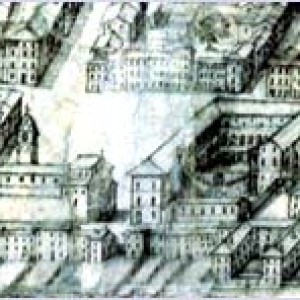
The Ducal Palace, with its majesty (82 meters along Piazza Aranci) and magnificence, is certainly the most imposing and perhaps the most beautiful monument in Massa. Its origins lie in the desire of Prince Alberico I Cybo–Malaspina to give his small state a dignity and image worthy of standing alongside the refined Italian principalities of the sixteenth century. After the refoundation and fortification of Massa Cybea in 1547, Alberico transformed the old house he owned on the plain village of Bagnara into a royal residence, moving the court from the overly austere and medieval Malaspina Castle. The orignal core of the present palace was therefore built between 1567 and 1570, extending from the upper corner to the ninth window of the facade.
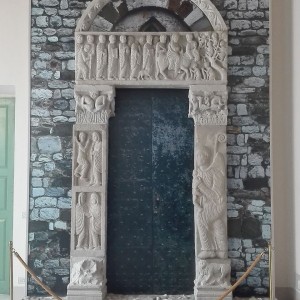
The numerous asymmetries visible on the main facade can be explained by the stages of its construction and testify to the successive interventions made by different rules to increase the symbolic importance of the ducal residence. Carlo I, who succeded Alberico, wished to provide the palace with a reception hall worthy of the family splendor of his wife, Veronica Cybo, and of the Genoese residences in which she had grown up. He therefore added to the grand hall known as the Hall of the Swiss (Salone degli Svizzeri), effectively doubling the length of the facade. This also required relocating the main entrance portal, which, to better match the grandeur of the complex, was enhanced with the beautiful terrace above it, decorated with marble friezes and statues.
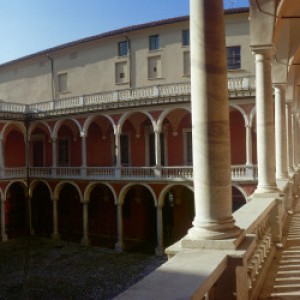
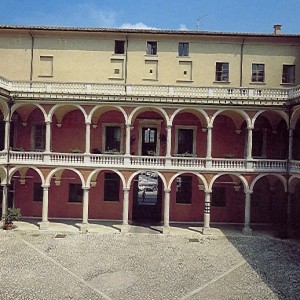
This architectural feature was later imitated in many private palaces throughout the city. His successor, Alberico II, continued expanding the palace by constructing a third wing parallel to the facade. He brilliantly resolved the overall balance of the complex by closing the courtyard with a loggia, which at that time opened toward a view of the sea. In doing so, he created within the palace, during the height of the Baroque period, a magnificent example of a sixteenth-century courtyard clearly inspired by Bramante.
The architect behind this harmonious design was Giovanni Francesco Bergamini, around 1670, a member of a family of architects who shaped Cybo–Malaspina architecture for two centuries. The beauty of the ensemble, diminished today by the loss of the perspective that once gave immense breath to the double loggia, celebrates a true triumph of marble through its “one hundred columns.” The definitive arrangement of the imposing complex, which successive enlargements had rendered stylistically inconsistent, was due to the energetic and skillful hand of Teresa Pamphilj, wife of Duke Carlo II.
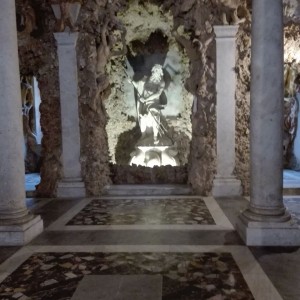
Recalling the splendors of Rome’s palaces, she wished to give the facade princely dignity. She therefore commissioned Alessandro Bergamini to harmonize the main facade, achieving the results we see today. By skillfully contrasting the red Cybo color with the whiteness of marble and stucco, Bergamini lightened the building’s mass through various devices (paired brackets on the cornice, balustrades on the top floor echoed in the ground-floor windows, the upward thrust of the plaster busts, and so forth), while cleverly concealing its asymmetries. Teresa also devoted attention to the interior, commissioning a “grotesque” architectural composition that serves as a theatrical backdrop to the main entrance, as well as the decoration of the two adjoining rooms, where she celebrated the glory of the Pamphilj and Cybo families and embellished the great hall. The palace underwent one final major alteration in 1806, when Elisa Baciocchi, seeking to create a large Napoleonic-style square, ordered the demolition of the Parish Church of S. Pietro, which had stood in front of the palace, along with the elevated passageway that connected it to the Ducal Chapel. A visible trace of the chapel remains on the facade.
Once home to a magnificent picture gallery containing works by Leonardo, Raffaello, Tiziano, Giorgione, Guercino, and other great Italian artists, the palace today preserves only those artworks that escaped the disastrous squandering of Duke Alderano and the plundering carried out by the French Revolutionary armies. At the end of the courtyard stands the Grotesque, influenced by Ligurian and Roman styles, where stuccodecorations of varying quality surround the large statue of Neptune, creating an overall pleasing effect.
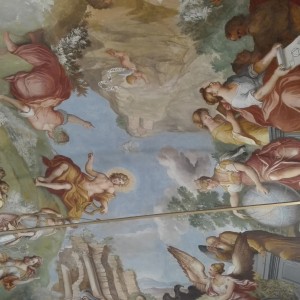
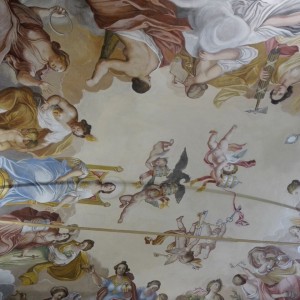
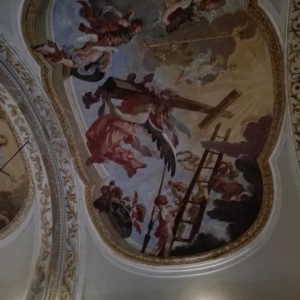
In the two adjoining rooms (which once housed the Academy of the Renewed), the talents of the painter Stefano Lemmi of Fivizzano are evident in the two frescoed ceilings, one of which has been marred by an unfortunate restoration. The first depicts the glory of the four Popes belonging to the Cybo and Pamphilj families, though it has been obscured by regrettable repainting. The second, in which the virtues of intellect are represented allegorically, still demonstrates the quality of Lemmi’s work.
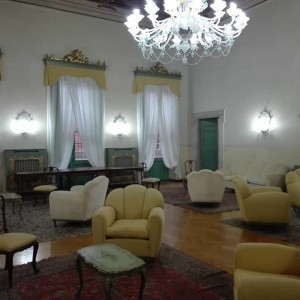
The Hall of the Swiss has regained part of its decoration through recent restoration. Several painters worked on it under the direction of Francesco Natali of Cremona. However, what can be seen today is the result of an early nineteenth-century reconstruction, since Natali’s original ceiling was destroyed by fire and later redesigned by Saverio Salvioni and executed by Giuseppe Reggini of Reggio Emilia. In the adjoining room, known as the Hall of Mirrors, a large and finely executed painting is preserved.
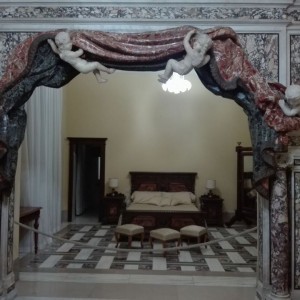
Some works created by the marble masters of Carrara and local workshops remain intact. Among them stands out the Alcove of Duke Carlo II, designed and executed by Alessandro Bergamini for Teresa Pamphilj between 1695 and 1696. Here, the theatrical invention of a false drapery supported by charming cherubs is realized through an impressive display of precious marbles, demonstrating the skill of local craftsmen.
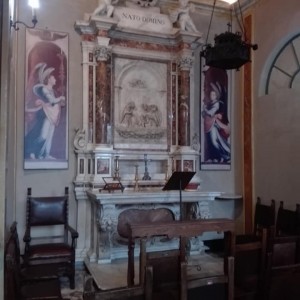
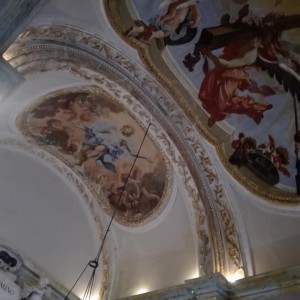
In the Ducal Chapel, once adorned with works by Pietro Tacca, traces of its former splendor remain visible. These include the beautiful frescoed ceilings painted with remarkable effect by the Carrara artist Carlo Pellegrini in 1646 and a marble altarpiece depicting the Nativity, sometimes attributed to Matteo Civitali but more likely an outstanding work by local artists.